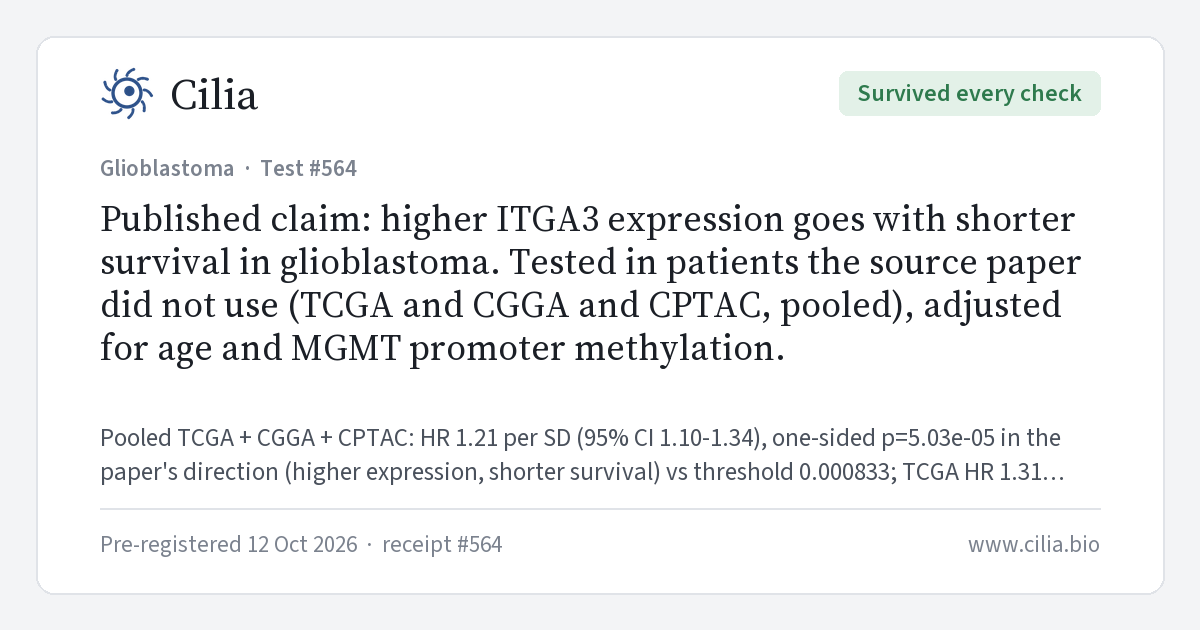
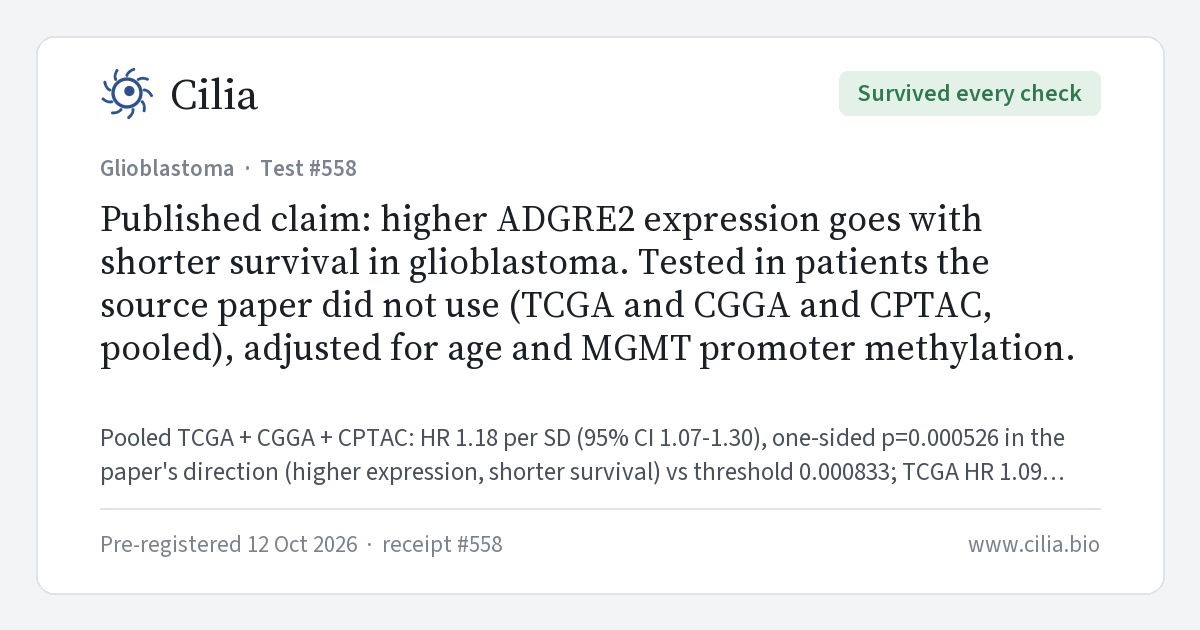
14 results held up out of 623 pre-registered tests. Each is listed here in plain words, newest first, with how sure it is and the key numbers. Most tests do not hold up; those are counted at the end.
These are statistical tests on public data. A result that holds up is a lead for researchers, not clinical evidence, and nothing here is medical advice.
Alzheimer's disease
survivedPublished claimTest #61712 Oct 2026
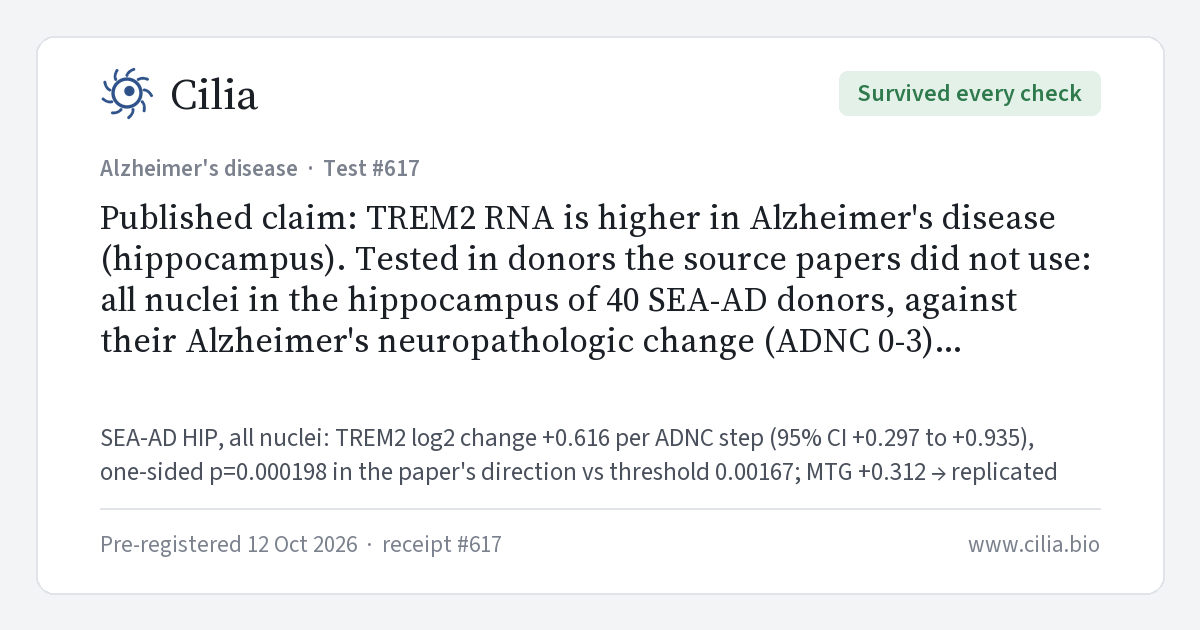
TREM2 RNA is higher with more Alzheimer's pathology, as three papers reported, and this held up in the hippocampus of 40 brain donors the papers did not use (SEA-AD).
How sure. The result held up, and the automatic skeptic review found no problem.
“An increase in TREM2 mRNA expression has been observed in the hippocampus and temporal cortex of AD patients.”
- log2 fold change +0.616 per step of Alzheimer's neuropathologic change (95% CI +0.297 to +0.935); one-sided p = 2.0e-4 in the paper's direction, against a threshold of 0.0017 set before the test.
- 40 SEA-AD donors, all nuclei in the hippocampus, adjusted for age, sex and post-mortem interval.
- middle temporal gyrus (same donors): +0.312.
Sources: PMCID:PMC9320643; Microglial Hyperreactivity Evolved to Immunosuppression in the Hippocampus of a Mouse… (Frontiers in aging neuroscience, 2020); Profile of TREM2-Derived circRNA and mRNA Variants in the Entorhinal Cortex of… (International journal of molecular sciences, 2022); SEA-AD, Seattle Alzheimer's Disease Brain Cell Atlas
Full test and receiptShare imageChallenge this result
challengedHuman geneticsTest #53312 Oct 2026
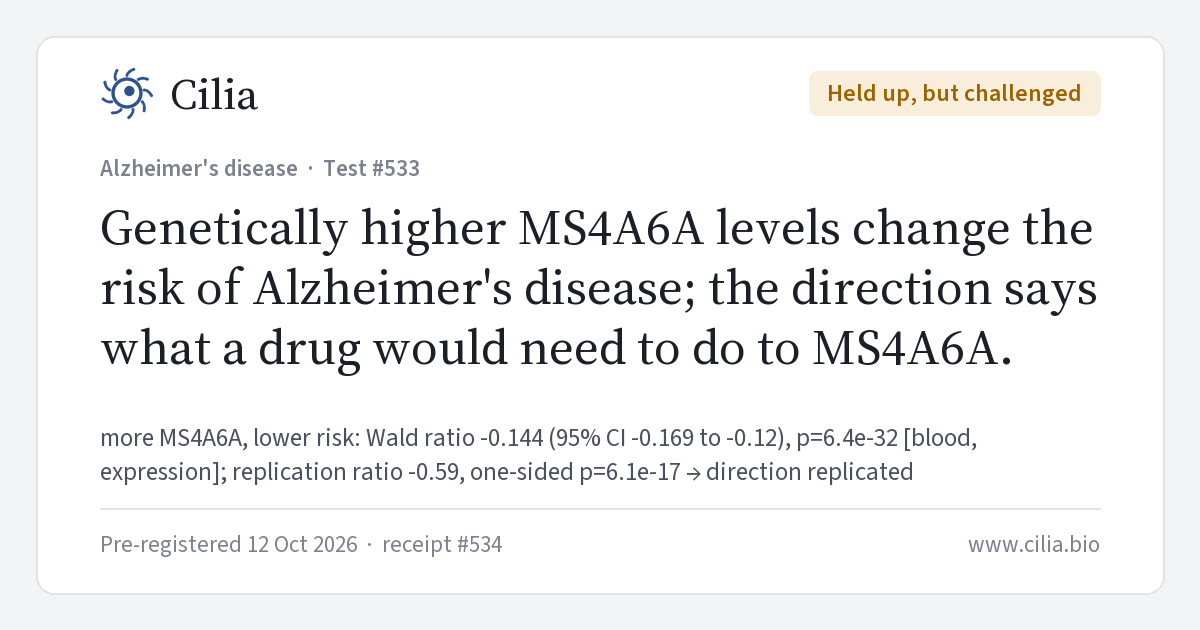
Genetically higher MS4A6A levels go with a lower risk of Alzheimer's disease in two genetic studies. No drug in Alzheimer's disease trials is listed as acting on MS4A6A.
How sure. The result held up, but the automatic skeptic review raised four concerns: the estimate comes from blood and immune cells, not brain, so it may not reflect MS4A6A in the brain; measurements of MS4A6A in different tissues do not all point the same way; the same genetic signal also tracks other nearby genes (MS4A4A, MS4A4E), so the risk may run through one of them; the genetic variant used changes the MS4A6A protein itself, so the link may come from what the protein does rather than how much of it there is.
- First study: EADB 2026 (56,184 cases, 90,919 controls), p = 6.4e-32.
- Second study: FinnGen R12 (13,964 cases), same direction, one-sided p = 6.1e-17.
- MS4A6A levels: gene expression in blood (GTEx-v10), variant rs7232.
Sources: MS4A6A on Open Targets; EADB 2026 GWAS; FinnGen R12 GWAS
Full test and receiptShare imageChallenge this result
survivedHuman geneticsTest #53212 Oct 2026
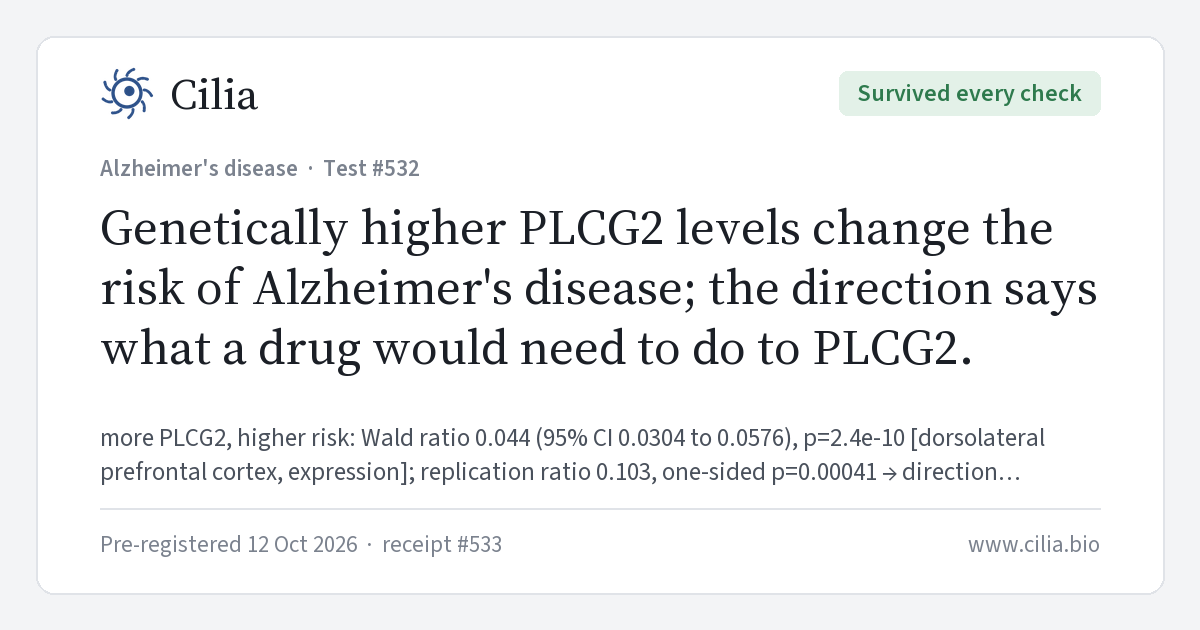
Genetically higher PLCG2 levels go with a higher risk of Alzheimer's disease in two genetic studies. No drug in Alzheimer's disease trials is listed as acting on PLCG2.
How sure. The result held up, and the automatic skeptic review found no problem.
- First study: EADB 2026 (56,184 cases, 90,919 controls), p = 2.4e-10.
- Second study: FinnGen R12 (13,964 cases), same direction, one-sided p = 4.1e-4.
- PLCG2 levels: gene expression in dorsolateral prefrontal cortex (BrainSeq), variant rs1071644.
Sources: PLCG2 on Open Targets; EADB 2026 GWAS; FinnGen R12 GWAS
Full test and receiptShare imageChallenge this result
challengedHuman geneticsTest #53112 Oct 2026
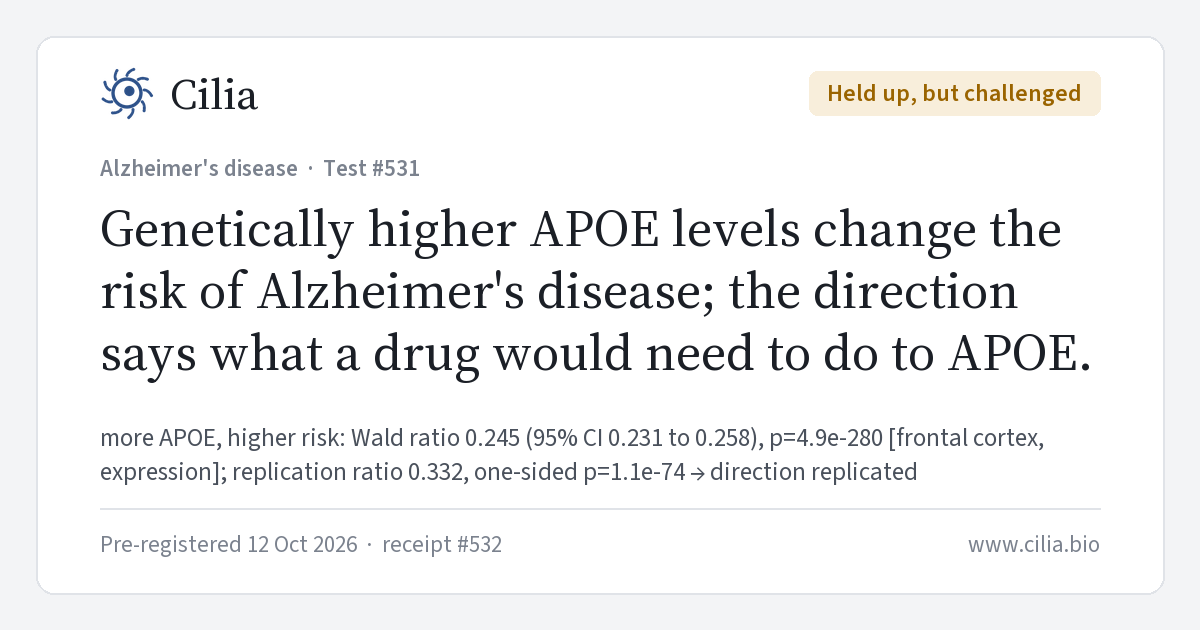
Genetically higher APOE levels go with a higher risk of Alzheimer's disease in two genetic studies. No drug in Alzheimer's disease trials is listed as acting on APOE.
How sure. The result held up, but the automatic skeptic review raised four concerns: measurements of APOE in different tissues do not all point the same way; three other genetic signals near APOE point the other way; the same genetic signal also tracks other nearby genes (APOC1), so the risk may run through one of them; the variant sits in the APOE region on chromosome 19, where one-variant estimates are unreliable.
- First study: EADB 2026 (56,184 cases, 90,919 controls), p = 4.9e-280.
- Second study: FinnGen R12 (13,964 cases), same direction, one-sided p = 1.1e-74.
- APOE levels: gene expression in frontal cortex (GTEx-v10), variant rs440446.
Sources: APOE on Open Targets; EADB 2026 GWAS; FinnGen R12 GWAS
Full test and receiptShare imageChallenge this result
challengedHuman geneticsTest #53012 Oct 2026
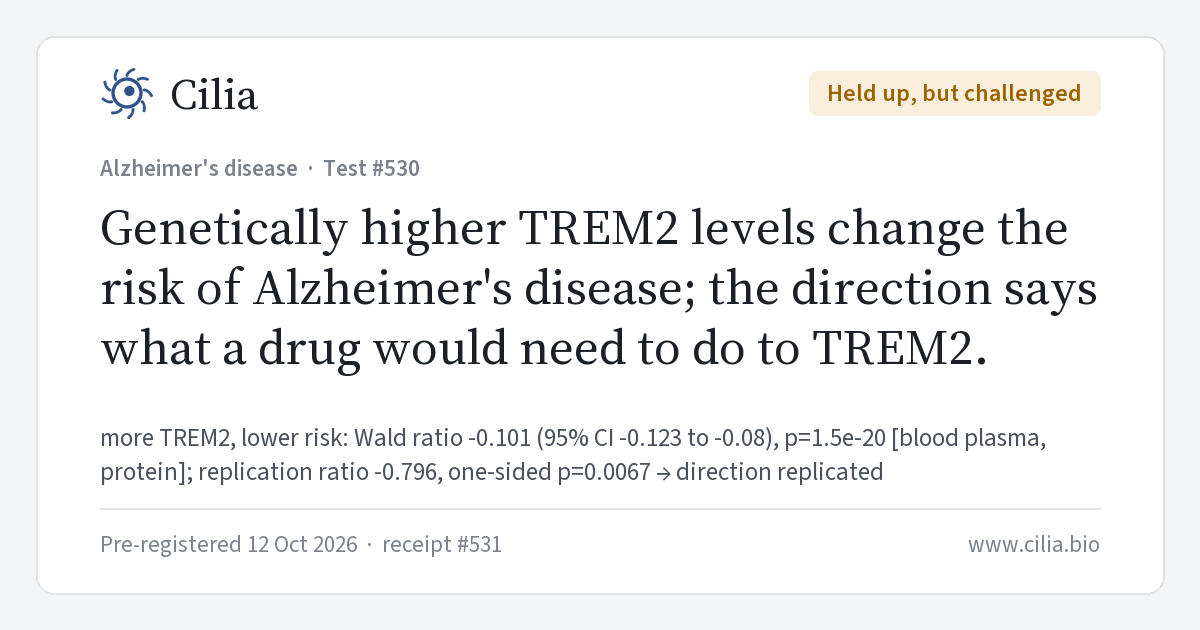
Genetically higher TREM2 levels go with a lower risk of Alzheimer's disease in two genetic studies. No drug in Alzheimer's disease trials is listed as acting on TREM2.
How sure. The result held up, but the automatic skeptic review raised three concerns: the estimate comes from plasma protein, not brain, so it may not reflect TREM2 in the brain; another genetic signal near TREM2 points the other way; the genetic variant used changes the TREM2 protein itself, which can distort the protein measurement.
- First study: EADB 2026 (56,184 cases, 90,919 controls), p = 1.5e-20.
- Second study: FinnGen R12 (13,964 cases), same direction, one-sided p = 0.0067.
- TREM2 levels: protein level in blood plasma (UKB_PPP_EUR), variant rs143332484.
Sources: TREM2 on Open Targets; EADB 2026 GWAS; FinnGen R12 GWAS
Full test and receiptShare imageChallenge this result
challengedHuman geneticsTest #52912 Oct 2026
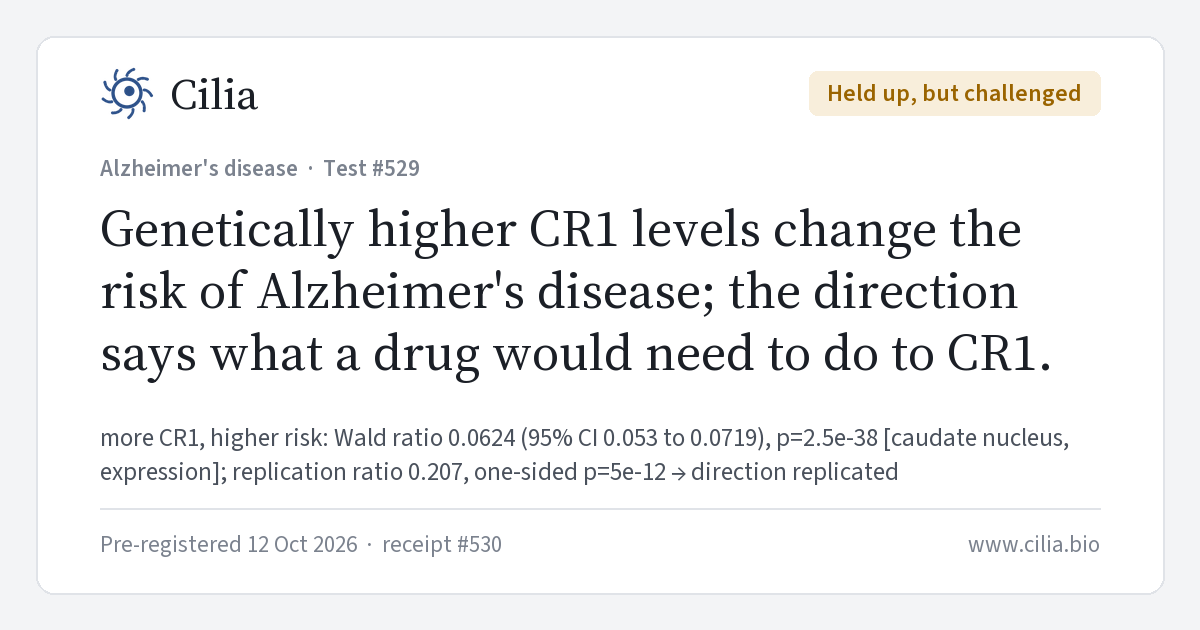
Genetically higher CR1 levels go with a higher risk of Alzheimer's disease in two genetic studies. No drug in Alzheimer's disease trials is listed as acting on CR1.
How sure. The result held up, but the automatic skeptic review raised a concern: the same genetic signal also tracks other nearby genes (EIF2D), so the risk may run through one of them.
- First study: EADB 2026 (56,184 cases, 90,919 controls), p = 2.5e-38.
- Second study: FinnGen R12 (13,964 cases), same direction, one-sided p = 5.0e-12.
- CR1 levels: gene expression in caudate nucleus (GTEx-v10), variant rs679515.
Sources: CR1 on Open Targets; EADB 2026 GWAS; FinnGen R12 GWAS
Full test and receiptShare imageChallenge this result
challengedHuman geneticsTest #52812 Oct 2026
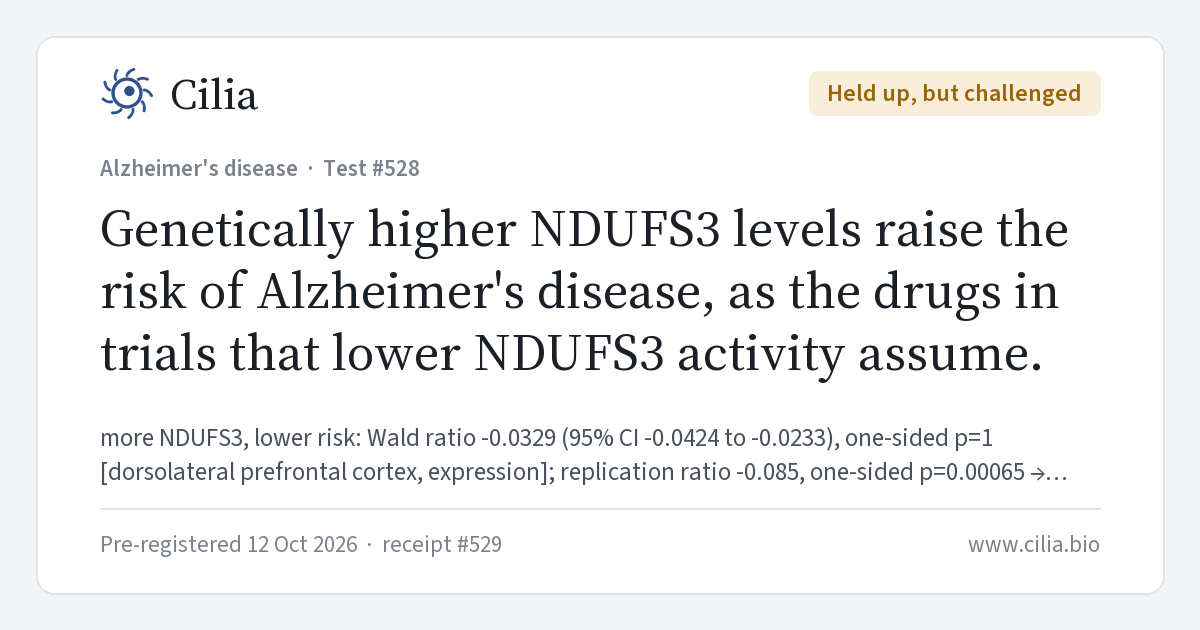
Genetically higher NDUFS3 levels go with a lower risk of Alzheimer's disease in two genetic studies — the opposite of what the trial drugs that lower NDUFS3 (metformin) assume.
How sure. The result held up, but the automatic skeptic review raised two concerns: the genetic signals for NDUFS3 levels and for the disease may not come from the same variant; the same genetic signal also tracks other nearby genes (ACP2, C1QTNF4, FAM180B and 2 more), so the risk may run through one of them.
- First study: EADB 2026 (56,184 cases, 90,919 controls), one-sided p = 7.2e-12.
- Second study: FinnGen R12 (13,964 cases), same direction, one-sided p = 6.5e-4.
- NDUFS3 levels: gene expression in dorsolateral prefrontal cortex (GTEx-v10), variant rs1057233.
Sources: NDUFS3 on Open Targets; EADB 2026 GWAS; FinnGen R12 GWAS
Full test and receiptShare imageChallenge this result
challengedHuman geneticsTest #52712 Oct 2026
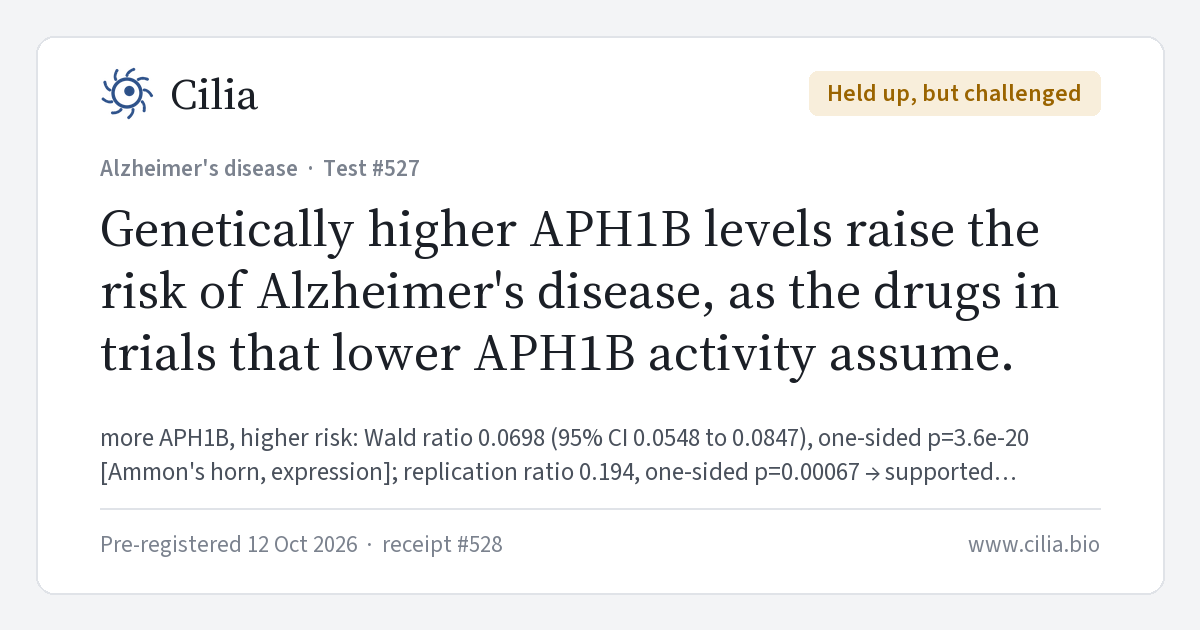
Genetically higher APH1B levels go with a higher risk of Alzheimer's disease in two genetic studies, which agrees with the trial drugs that lower APH1B (semagacestat, avagacestat and others).
How sure. The result held up, but the automatic skeptic review raised a concern: the genetic variant used changes the APH1B protein itself, so the link may come from what the protein does rather than how much of it there is.
- First study: EADB 2026 (56,184 cases, 90,919 controls), one-sided p = 3.6e-20.
- Second study: FinnGen R12 (13,964 cases), same direction, one-sided p = 6.7e-4.
- APH1B levels: gene expression in Ammon's horn (GTEx-v10), variant rs117618017.
Sources: APH1B on Open Targets; EADB 2026 GWAS; FinnGen R12 GWAS
Full test and receiptShare imageChallenge this result
challengedHuman geneticsTest #52612 Oct 2026
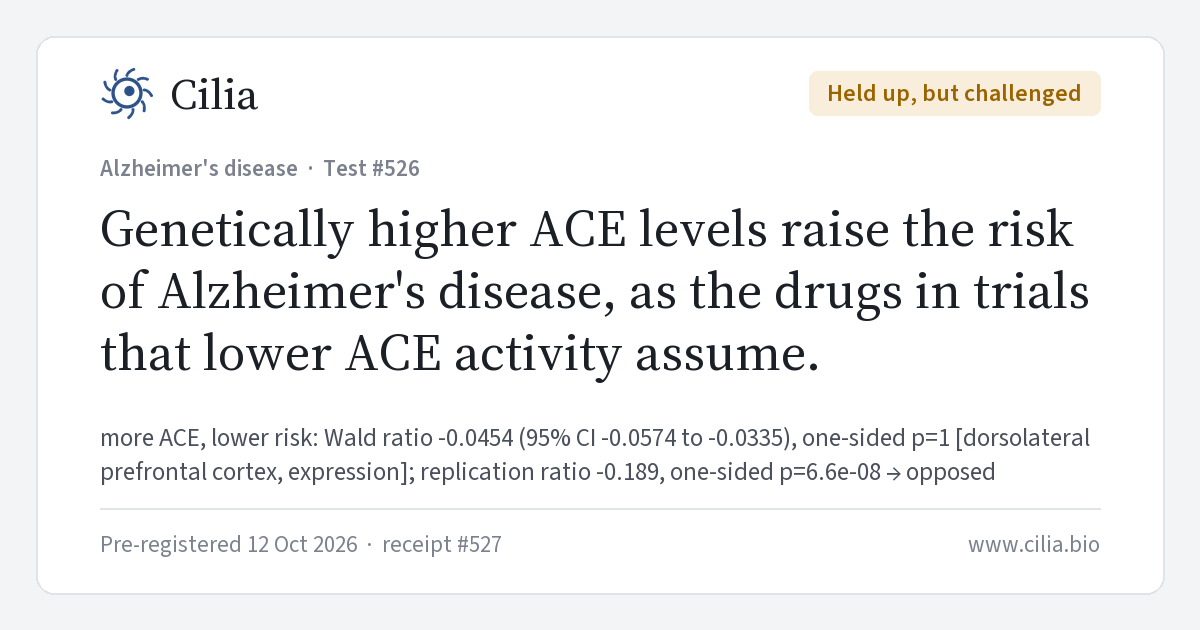
Genetically higher ACE levels go with a lower risk of Alzheimer's disease in two genetic studies — the opposite of what the trial drugs that lower ACE (perindopril) assume.
How sure. The result held up, but the automatic skeptic review raised two concerns: measurements of ACE in different tissues do not all point the same way; the same genetic signal also tracks other nearby genes (CYB561, DCAF7 and 1 more), so the risk may run through one of them.
- First study: EADB 2026 (56,184 cases, 90,919 controls), one-sided p = 4.4e-14.
- Second study: FinnGen R12 (13,964 cases), same direction, one-sided p = 6.6e-8.
- ACE levels: gene expression in dorsolateral prefrontal cortex (BrainSeq), variant rs4292.
Sources: ACE on Open Targets; EADB 2026 GWAS; FinnGen R12 GWAS
Full test and receiptShare imageChallenge this result
Parkinson's disease
challengedHuman geneticsTest #51012 Oct 2026
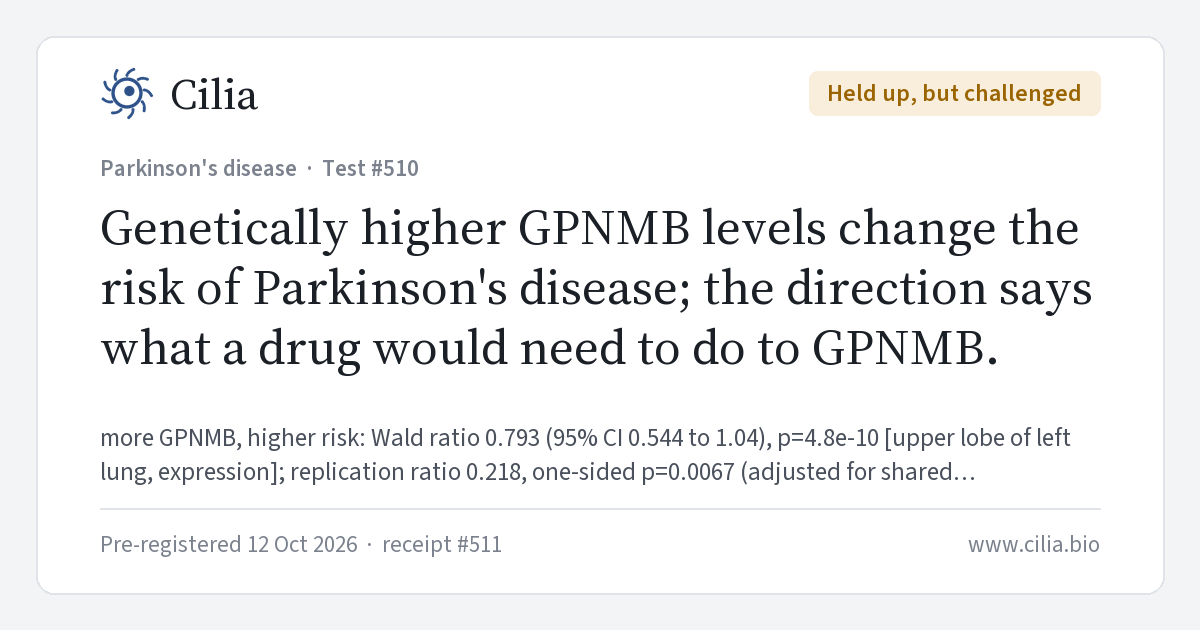
Genetically higher GPNMB levels go with a higher risk of Parkinson's disease in two genetic studies. No drug in Parkinson's disease trials is listed as acting on GPNMB.
How sure. The result held up, but the automatic skeptic review raised three concerns: the estimate comes from other tissues, not brain, so it may not reflect GPNMB in the brain; Open Targets rates NUP42 as the more likely gene at this signal; the same genetic signal also tracks other nearby genes (KLHL7, KLHL7-DT, NUP42 and 1 more), so the risk may run through one of them.
LLM reviewer. 4 concerns, for example: The discovery Wald ratio is about 3.6 times the replication ratio even though both use the same variant and QTL. The discovery GWAS is diluted by proxy cases, which should make it smaller, not larger. The gap points to… All notes
- First study: Kim JJ 2023 (42,792 cases, 568,693 controls), p = 4.8e-10.
- Second study: FinnGen R12 (5,861 cases), same direction, one-sided p = 0.0067.
- GPNMB levels: gene expression in upper lobe of left lung (GTEx-v10), variant rs1881200.
Sources: GPNMB on Open Targets; Kim JJ 2023 GWAS; FinnGen R12 GWAS
Full test and receiptShare imageChallenge this result
challengedHuman geneticsTest #50412 Oct 2026
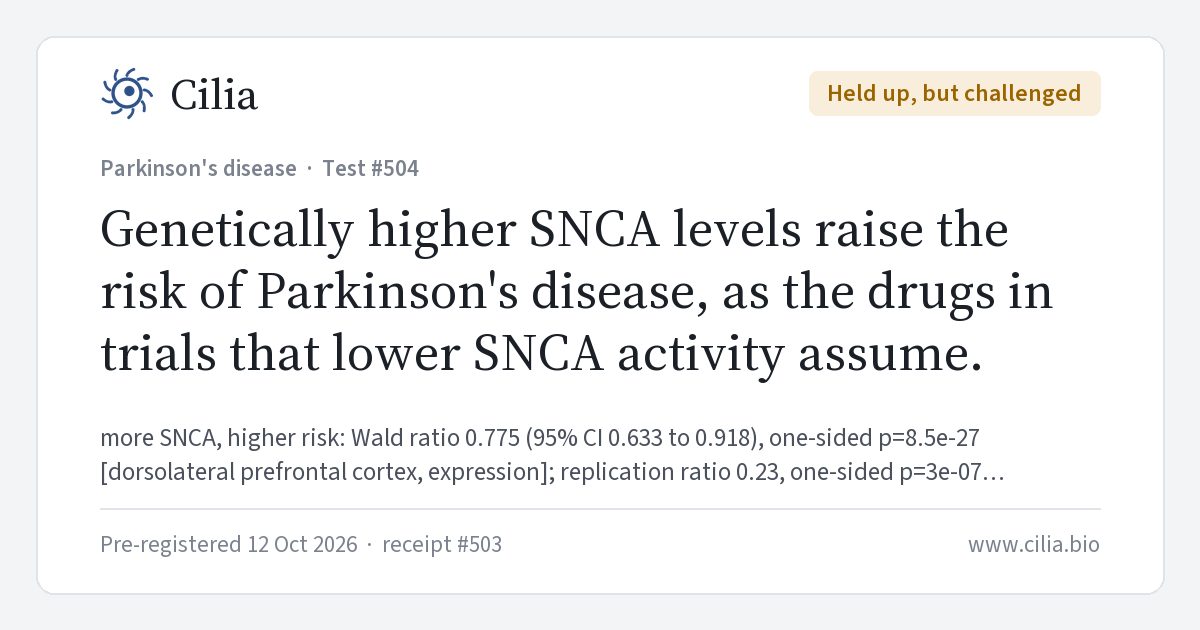
Genetically higher SNCA levels go with a higher risk of Parkinson's disease in two genetic studies, which agrees with the trial drugs that lower SNCA (cinpanemab).
How sure. The result held up, but the automatic skeptic review raised two concerns: measurements of SNCA in different tissues do not all point the same way; another genetic signal near SNCA points the other way.
LLM reviewer. 4 concerns, for example: Cinpanemab and prasinezumab are antibodies against extracellular, aggregated alpha-synuclein protein. They do not lower SNCA gene expression. A lifelong, genetically higher level of brain SNCA mRNA is therefore a weak… All notes
- First study: Kim JJ 2023 (42,792 cases, 568,693 controls), one-sided p = 8.5e-27.
- Second study: FinnGen R12 (5,861 cases), same direction, one-sided p = 3.0e-7.
- SNCA levels: gene expression in dorsolateral prefrontal cortex (GTEx-v10), variant rs2736989.
Sources: SNCA on Open Targets; Kim JJ 2023 GWAS; FinnGen R12 GWAS
Full test and receiptShare imageChallenge this result