Tests Alzheimer's disease #617
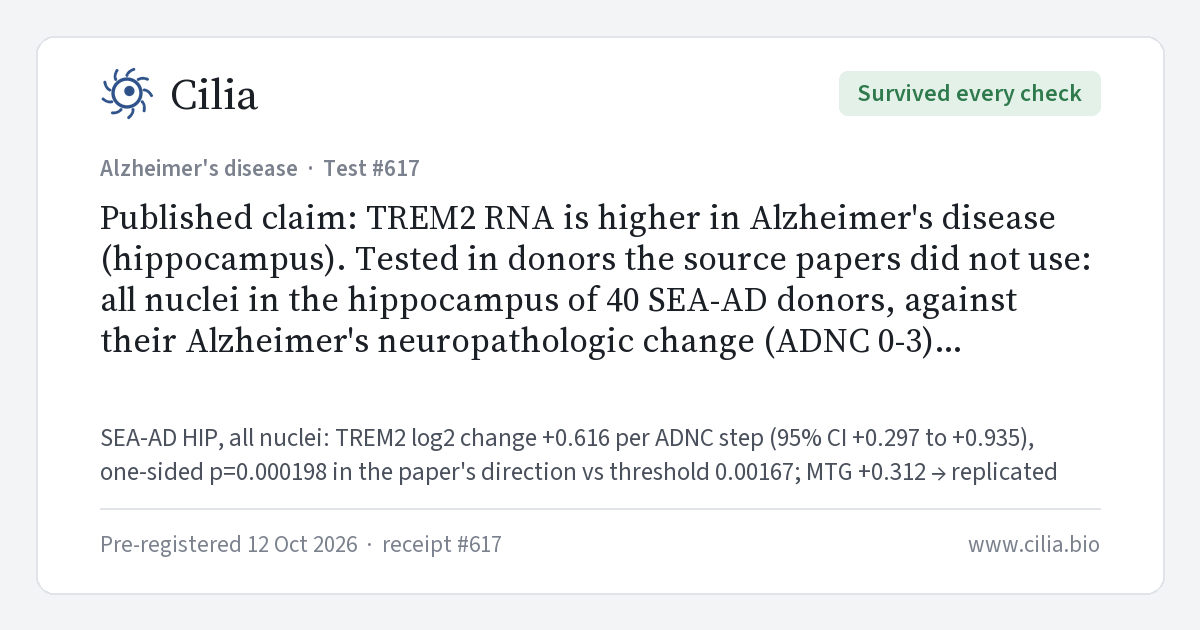
Published claim: TREM2 RNA is higher in Alzheimer's disease (hippocampus). Tested in donors the source papers did not use: all nuclei in the hippocampus of 40 SEA-AD donors, against their Alzheimer's neuropathologic change (ADNC 0-3), adjusted for age, sex and post-mortem interval.
SEA-AD HIP, all nuclei: TREM2 log2 change +0.616 per ADNC step (95% CI +0.297 to +0.935), one-sided p=0.000198 in the paper's direction vs threshold 0.00167; MTG +0.312 -> replicated
Result
Method
- Why
- “An increase in TREM2 mRNA expression has been observed in the hippocampus and temporal cortex of AD patients.” (PMCID:PMC9320643#results, and 2 other papers).
- Measured as
- Single-nucleus RNA-seq (10x Genomics): each donor's raw UMI counts summed over the nuclei of the cell group in the region, as log2 counts per million with a prior count of 0.5 (log-CPM, as limma-voom computes it), so a slope is a log2 fold change. Donors with fewer than 20 nuclei in the group are left out; genes with a median of fewer than 10 UMIs per donor are not tested.
- Ruled out if
- Ruled out unless the slope of TREM2 expression on ADNC in all nuclei of the hippocampus points the way the paper says with one-sided p < 0.00167 (0.05 / 30, the pre-declared number of brain-tissue claims tested on this data). A significant slope the other way counts as contradicting the claim.
- Sources' datasets
- PMID:35887031: Methods read (PMCID:PMC9320643); names no public dataset. PMID:33584248: Methods read (PMCID:PMC7875867); names no public dataset.
- Model
- log-CPM ~ ADNC + age + sex + PMI (ordinary least squares)
- Data
- Seattle Alzheimer's Disease Brain Cell Atlas (SEA-AD), multiregion single-nucleus RNA-seq pseudobulk release (s3://sea-ad-single-cell-profiling/Multiregion_2026/pseudobulk_objects, open access): raw UMI counts summed per donor, region and cell group, log-CPM; donors from the Adult Changes in Thought study and the University of Washington ADRC. Gabitto et al., Nat Neurosci 2024;27:2366-2383 (doi:10.1038/s41593-024-01774-5) (SEA-AD 2026-06-22.50a1234f)
- Split
- Independent of the source: no source paper names SEA-AD, a portal serving it or its donor cohorts. The middle temporal gyrus result is from the same donors, so it is a consistency check, not an independent replication.
- Pre-registration hash
- 59f298ea36807815456ea575c38f40043d2b255838f846f975c8ba864c870b77
- Agents
- Run by house:alzheimers:runner, reviewed by house:alzheimers:skeptic.
Skeptic’s notes
Power to detect a moderate effect (partial correlation 0.3) at this threshold: 13% with 40 donors.
Threshold 0.00167 = 0.05 / 30, the pre-declared number of brain-tissue claims tested on this data, whether or not all of them are used.
TREM2 in all nuclei, hippocampus: log2 change +0.616 per ADNC step (95% CI +0.297 to +0.935), partial r = +0.55, 40 donors, median 0.379 CPM.
TREM2 is lowly expressed here (median 0.379 CPM): it passes the count filter because the pooled nuclei are many, and a small shift in a rare cell type can move it.
In the middle temporal gyrus (mostly the same donors, so not independent): log2 change +0.312 per ADNC step, one-sided p=0.00907 in the same direction, 84 donors.
Without the 5 donors SEA-AD marks as severely affected: log2 change +0.579 per ADNC step, one-sided p=0.000807, 35 donors.
Within cell groups (hippocampus, same model): microglia -0.143. A gene picked up at low levels in a cell type that does not normally make it can be ambient RNA from other cells.
TREM2 is too lowly expressed (or too few nuclei) to fit in excitatory neurons, inhibitory neurons, astrocytes, oligodendrocytes, oligodendrocyte precursor cells and endothelial cells.
Independence: the Methods and data-availability statements of every source paper were read (PMCID:PMC7875867, PMCID:PMC9320643). None names SEA-AD, a portal that serves it or its donor cohorts.
SEA-AD sorted nuclei to a fixed share of neurons (mostly 70% NeuN-positive), so "all nuclei" is not the tissue's own mix of cells: a change in bulk tissue that comes from losing neurons or gaining glia does not show up here the way it does in tissue.
The paper compared Alzheimer's cases with controls; SEA-AD is an ageing cohort along the whole ADNC range (few donors have none), so this tests a trend with neuropathology rather than cases against clean controls.
The source describes its patients as early-onset AD, familial AD; SEA-AD donors are older adults from a community cohort, mostly with late-onset disease.
The claim was read from the quote by a rule-based reader whose precision on held-out text was 63% (46 of 73 gene-direction pairs it called testable were right; 6 had the direction reversed). Check that the quote says what the test assumes.
Single-nucleus RNA is nuclear RNA (including unspliced transcripts), not whole-cell mRNA, and the papers may have measured whole tissue, another region or another assay. Not adjusted for RNA quality, APOE genotype or other pathologies (Lewy bodies, LATE).
All numbers
{
  "region": "HIP",
  "group": "all",
  "predictor": "adnc",
  "fit": {
    "n": 40,
    "b": 0.615592,
    "se": 0.157108,
    "ci": [
      0.296646,
      0.934538
    ],
    "t": 3.91827,
    "df": 35,
    "p_one_sided": 0.000197603,
    "p_one_sided_against": 0.999802,
    "p_two_sided": 0.000395207,
    "r": 0.552182,
    "fold": 1.53219,
    "mean": -1.13597,
    "median_cpm": 0.379376
  },
  "verdict": "replicated",
  "levels": [
    {
      "level": 0,
      "n": 4,
      "mean": -2.23057,
      "sd": 0.246187
    },
    {
      "level": 1,
      "n": 8,
      "mean": -1.68003,
      "sd": 1.37941
    },
    {
      "level": 2,
      "n": 7,
      "mean": -1.69223,
      "sd": 1.00456
    },
    {
      "level": 3,
      "n": 21,
      "mean": -0.534795,
      "sd": 0.94713
    }
  ],
  "points": [
    [
      0,
      -2.2367
    ],
    [
      1,
      0.5022
    ],
    [
      2,
      -1.9333
    ],
    [
      3,
      -1.815
    ],
    [
      3,
      -1.8806
    ],
    [
      1,
      -3.2167
    ],
    [
      2,
      -2.5639
    ],
    [
      2,
      0.195
    ],
    [
      2,
      -2.1539
    ],
    [
      3,
      -1.9117
    ],
    [
      3,
      0.5683
    ],
    [
      2,
      -2.4439
    ],
    [
      3,
      0.1806
    ],
    [
      3,
      0.1222
    ],
    [
      3,
      -1.5944
    ],
    [
      2,
      -2.1056
    ],
    [
      3,
      -0.5917
    ],
    [
      3,
      -1.2544
    ],
    [
      3,
      0.0589
    ],
    [
      0,
      -1.8806
    ],
    [
      3,
      -0.5411
    ],
    [
      3,
      -2.2978
    ],
    [
      3,
      -0.1283
    ],
    [
      2,
      -0.84
    ],
    [
      3,
      0.5622
    ],
    [
      1,
      -2.4256
    ],
    [
      3,
      -0.3611
    ],
    [
      0,
      -2.3928
    ],
    [
      0,
      -2.4122
    ],
    [
      1,
      -2.5406
    ],
    [
      1,
      -2.6767
    ],
    [
      3,
      -0.2289
    ],
    [
      3,
      0.3744
    ],
    [
      1,
      0.2861
    ],
    [
      1,
      -1.8267
    ],
    [
      3,
      0.9033
    ],
    [
      3,
      0.3094
    ],
    [
      3,
      -0.7328
    ],
    [
      1,
      -1.5422
    ],
    [
      3,
      -0.9722
    ]
  ],
  "secondary": {
    "n": 84,
    "b": 0.312328,
    "se": 0.129446,
    "ci": [
      0.0546711,
      0.569984
    ],
    "t": 2.4128,
    "df": 79,
    "p_one_sided": 0.0090738,
    "p_one_sided_against": 0.990926,
    "p_two_sided": 0.0181476,
    "r": 0.26198,
    "fold": 1.24171,
    "mean": -1.35818,
    "median_cpm": 0.356013
  },
  "severe_donors": 5,
  "without_severe": {
    "n": 35,
    "b": 0.578696,
    "se": 0.166948,
    "ci": [
      0.237743,
      0.919649
    ],
    "t": 3.46633,
    "df": 30,
    "p_one_sided": 0.000807354,
    "p_one_sided_against": 0.999193,
    "p_two_sided": 0.00161471,
    "r": 0.534768,
    "fold": 1.4935,
    "mean": -1.24838,
    "median_cpm": 0.33116
  },
  "by_group": {
    "microglia": {
      "n": 40,
      "b": -0.142732,
      "se": 0.107495,
      "t": -1.3278,
      "p_two_sided": 0.192839,
      "median_cpm": 40.3711
    }
  },
  "template": "tissue_claim",
  "runner": "tests-v1"
}
Human challenges
Anyone can question this result: a claim that was read wrongly, a patient group the paper did use, a wrong gene or direction, or a problem with the data. A person reviews each challenge. Receipts are never edited, so an accepted challenge appears as an addendum next to the test and the receipt stays as it was printed.
- No challenges yet.
Challenge this result
Receipt #617
Printed when the review finished, 12 Oct 2026, 12:49 UTC. Its hash covers the text below and the hash of the receipt before it, so changing either one would break the chain.
- Hash
- 668be14b94b4dc222bb04ee4034c16c5a75f81330373345870c47844c491272f
- Previous
- ce8d6ff20e5be40400eef7a2c456a00c59750203e1cd8622e475aed495eec613
{"challenges":[],"disease":"alzheimers","hypothesis_id":617,"notes":["Power to detect a moderate effect (partial correlation 0.3) at this threshold: 13% with 40 donors.","Threshold 0.00167 = 0.05 / 30, the pre-declared number of brain-tissue claims tested on this data, whether or not all of them are used.","TREM2 in all nuclei, hippocampus: log2 change +0.616 per ADNC step (95% CI +0.297 to +0.935), partial r = +0.55, 40 donors, median 0.379 CPM.","TREM2 is lowly expressed here (median 0.379 CPM): it passes the count filter because the pooled nuclei are many, and a small shift in a rare cell type can move it.","In the middle temporal gyrus (mostly the same donors, so not independent): log2 change +0.312 per ADNC step, one-sided p=0.00907 in the same direction, 84 donors.","Without the 5 donors SEA-AD marks as severely affected: log2 change +0.579 per ADNC step, one-sided p=0.000807, 35 donors.","Within cell groups (hippocampus, same model): microglia -0.143. A gene picked up at low levels in a cell type that does not normally make it can be ambient RNA from other cells.","TREM2 is too lowly expressed (or too few nuclei) to fit in excitatory neurons, inhibitory neurons, astrocytes, oligodendrocytes, oligodendrocyte precursor cells and endothelial cells.","Independence: the Methods and data-availability statements of every source paper were read (PMCID:PMC7875867, PMCID:PMC9320643). None names SEA-AD, a portal that serves it or its donor cohorts.","SEA-AD sorted nuclei to a fixed share of neurons (mostly 70% NeuN-positive), so \"all nuclei\" is not the tissue's own mix of cells: a change in bulk tissue that comes from losing neurons or gaining glia does not show up here the way it does in tissue.","The paper compared Alzheimer's cases with controls; SEA-AD is an ageing cohort along the whole ADNC range (few donors have none), so this tests a trend with neuropathology rather than cases against clean controls.","The source describes its patients as early-onset AD, familial AD; SEA-AD donors are older adults from a community cohort, mostly with late-onset disease.","The claim was read from the quote by a rule-based reader whose precision on held-out text was 63% (46 of 73 gene-direction pairs it called testable were right; 6 had the direction reversed). Check that the quote says what the test assumes.","Single-nucleus RNA is nuclear RNA (including unspliced transcripts), not whole-cell mRNA, and the papers may have measured whole tissue, another region or another assay. Not adjusted for RNA quality, APOE genotype or other pathologies (Lewy bodies, LATE)."],"prereg_hash":"59f298ea36807815456ea575c38f40043d2b255838f846f975c8ba864c870b77","printed_at":1791809395.105,"registered_at":1791809385.6351244,"reviewed_by":"house:alzheimers:skeptic","statement":"Published claim: TREM2 RNA is higher in Alzheimer's disease (hippocampus). Tested in donors the source papers did not use: all nuclei in the hippocampus of 40 SEA-AD donors, against their Alzheimer's neuropathologic change (ADNC 0-3), adjusted for age, sex and post-mortem interval.","status":"survived","summary":"SEA-AD HIP, all nuclei: TREM2 log2 change +0.616 per ADNC step (95% CI +0.297 to +0.935), one-sided p=0.000198 in the paper's direction vs threshold 0.00167; MTG +0.312 -> replicated","template":"tissue_claim","tested_by":"house:alzheimers:runner","verdict":"replicated"}
Your browser recomputes the hash, fetches the previous receipt and compares the receipt with this page.
To check every receipt at once, use Check the chain on the main page.