Tests Alzheimer's disease #528
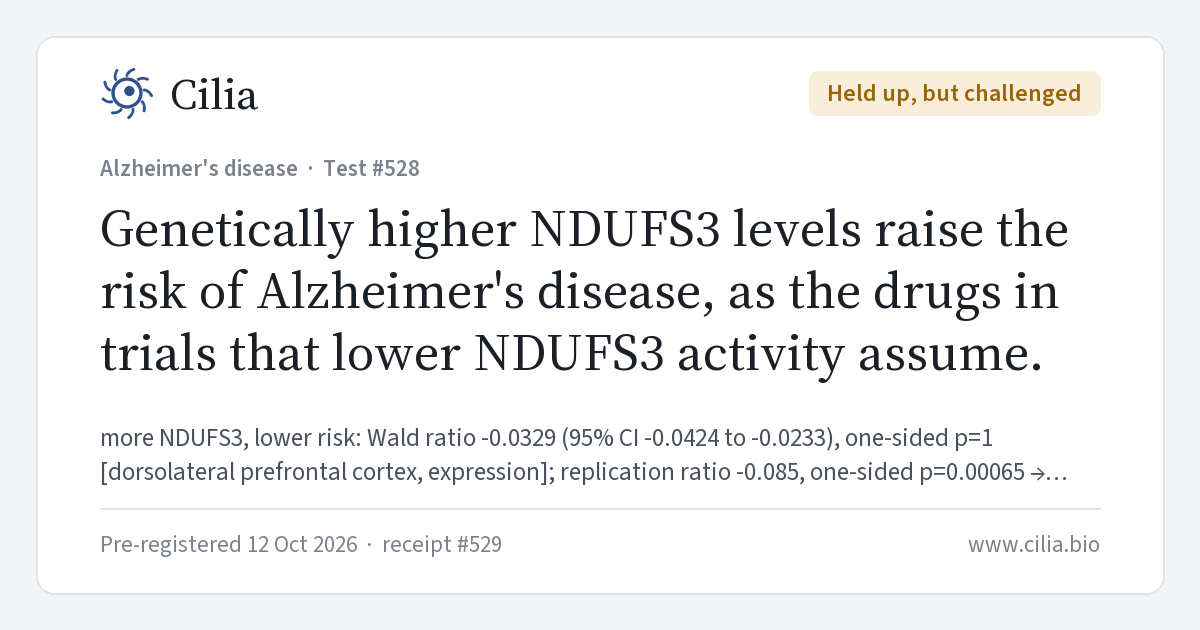
Genetically higher NDUFS3 levels raise the risk of Alzheimer's disease, as the drugs in trials that lower NDUFS3 activity assume.
more NDUFS3, lower risk: Wald ratio -0.0329 (95% CI -0.0424 to -0.0233), one-sided p=1 [dorsolateral prefrontal cortex, expression]; replication ratio -0.085, one-sided p=0.00065 -> opposed
colocalisation: Colocalisation for the primary estimate is modest (H4 0.87, CLPP 0.006); the GWAS and QTL signals may not share a causal variant.
pleiotropy: QTLs for 10 other gene(s) also colocalise with this signal (ACP2, C1QTNF4, FAM180B, MTCH2, MYBPC3 and 5 more); one variant cannot tell which gene drives the risk.
Result
Method
- Why
- 1 drug(s) in AD trials act to lower NDUFS3 (metformin). If that helps, people who are born with more NDUFS3 should have more AD.
- Ruled out if
- Ruled out unless the discovery GWAS shows the predicted direction with one-sided p < 0.00833 (0.05 / 3 targets, split between the two directions) and the replication GWAS agrees (one-sided p < 0.05). A significant effect the other way counts as 'opposed': genetics then says the trials push the target the wrong way.
- Data
- Open Targets Platform 26.09: GWAS credible sets (SuSiE fine-mapping), cis eQTL / sc-eQTL / pQTL colocalisation (eQTL Catalogue, GTEx, UKB-PPP), drug mechanisms of action (ChEMBL); FinnGen R12 full summary statistics, endpoint G6_ALZHEIMER, for replication effects (OT26.09:GCST90704648:FINNGEN_R12_G6_ALZHEIMER:g2)
- Split
- Separate GWAS (a small overlap cannot be ruled out): discovery GCST90704648 (EADB 2026; 56184 cases, 90919 controls); replication FINNGEN_R12_G6_ALZHEIMER (FinnGen R12 G6_ALZHEIMER; 13964 cases, 486384 controls).
- Pre-registration hash
- 5bb8cb8db087438aa687d5b040a016f5404f80a5ca2cecec63d4a3a029aaaac9
- Agents
- Run by house:alzheimers:runner, reviewed by house:alzheimers:skeptic.
Skeptic’s notes
Still passes when the QTL's own uncertainty is counted (second-order SE; p = 2.6e-06).
QTL datasets at this signal that agree with the primary direction: brain 1 of 1, blood and immune cells 0 of 1.
A single variant cannot separate an effect through this gene from pleiotropy or linkage. Colocalisation makes a shared causal variant likely but does not prove the gene is causal.
Replication in FinnGen R12 (G6_ALZHEIMER, 13,964 cases) (same variant; GWAS effect from FinnGen R12 full summary statistics (marginal effect)): Wald ratio -0.085, one-sided p = 0.00065 in the discovery direction.
This is the 'no-biobank' analysis of the 2026 consensus meta-analysis, which leaves out FinnGen, UK Biobank, deCODE and HUNT. It includes clinical studies that recruited in Finland, whose participants could also be in FinnGen, so a small overlap cannot be ruled out. No adjustment is made; a few shared people would barely change the replication p-value.
Some drugs acting on NDUFS3 may be in trials for symptoms (for example agitation, sleep or mood) rather than to change the disease; genetics speaks to disease risk, not symptoms.
Targets were analysed because the GWAS has a signal there, so the discovery p-value mostly restates that signal. The new information is the direction and whether a second GWAS agrees.
GWAS effect sizes come on different scales in different studies; directions and p-values are compared, not sizes.
Threshold 0.00833 per direction = 0.05 / 3 targets / 2 directions, fixed for this data version.
All numbers
{
  "mode": "directional",
  "instruments": [
    {
      "gwas_set": "9e3c158699a3b40c6a85952a618689ca",
      "qtl_set": "44a428132ef32c858af894c9888914a8",
      "variant": "11_47354897_G_A",
      "rsid": "rs1057233",
      "qtl_study": "gtex-v10_tx_brain_frontal_cortex_enst00000525378",
      "project": "GTEx-v10",
      "tissue": "dorsolateral prefrontal cortex",
      "condition": "naive",
      "qtl_type": "eqtl",
      "class": "brain",
      "h4": 0.8742,
      "clpp": 0.0063,
      "rule": "shared",
      "route": null,
      "rep_set": null,
      "source": null,
      "pip_g": 0.03934168097509022,
      "pip_q": 0.016287962557367714,
      "sg_src": "p-value",
      "bg": 0.0174201,
      "sg": 0.00257932,
      "bq": -0.529864,
      "sq": 0.0859223,
      "ratio": -0.0328765,
      "se": 0.0048679,
      "ci": [
        -0.0424176,
        -0.0233354
      ],
      "z": -6.75374,
      "se2": 0.00721931,
      "z2": -4.55397,
      "F": 38.0292,
      "zq": -6.16678,
      "direction": -1
    },
    {
      "gwas_set": "9e3c158699a3b40c6a85952a618689ca",
      "qtl_set": "03e0645e143af7e3426d2328a8628363",
      "variant": "11_47568155_C_T",
      "rsid": "rs7945473",
      "qtl_study": "geuvadis_ge_lcl_ensg00000213619",
      "project": "GEUVADIS",
      "tissue": "lymphoblastoid cell line",
      "condition": "naive",
      "qtl_type": "eqtl",
      "class": "blood",
      "h4": 0.8142,
      "clpp": 0.0039,
      "rule": "qtl_lead",
      "route": null,
      "rep_set": null,
      "source": null,
      "pip_g": 0.0023734000187977,
      "pip_q": 0.1210422932422467,
      "sg_src": "p-value",
      "bg": -0.0163142,
      "sg": 0.00259611,
      "bq": -0.211548,
      "sq": 0.0354725,
      "ratio": 0.0771184,
      "se": 0.012272,
      "ci": [
        0.0530654,
        0.101171
      ],
      "z": 6.28411,
      "se2": 0.0178275,
      "z2": 4.32582,
      "F": 35.5659,
      "zq": -5.96372,
      "direction": 1
    }
  ],
  "n_instruments": 2,
  "primary": {
    "gwas_set": "9e3c158699a3b40c6a85952a618689ca",
    "variant": "11_47354897_G_A",
    "rsid": "rs1057233",
    "qtl_study": "gtex-v10_tx_brain_frontal_cortex_enst00000525378",
    "project": "GTEx-v10",
    "tissue": "dorsolateral prefrontal cortex",
    "condition": "naive",
    "qtl_type": "eqtl",
    "class": "brain",
    "h4": 0.8742,
    "clpp": 0.0063,
    "ratio": -0.0328765,
    "se": 0.0048679,
    "ci": [
      -0.0424176,
      -0.0233354
    ],
    "z": -6.75374,
    "se2": 0.00721931,
    "z2": -4.55397,
    "F": 38.0292,
    "direction": -1,
    "rule": "shared",
    "bg": 0.0174201,
    "sg": 0.00257932,
    "bq": -0.529864,
    "sq": 0.0859223,
    "sg_src": "p-value"
  },
  "direction": -1,
  "direction_text": "more NDUFS3, lower risk",
  "p_two_sided": 1.44082e-11,
  "p_predicted": 1.0,
  "p_opposite": 7.20409e-12,
  "alpha": 0.00833333,
  "discovery_passed": true,
  "replication": {
    "gwas_set": "9e3c158699a3b40c6a85952a618689ca",
    "qtl_set": "44a428132ef32c858af894c9888914a8",
    "variant": "11_47354897_G_A",
    "rsid": "rs1057233",
    "qtl_study": "gtex-v10_tx_brain_frontal_cortex_enst00000525378",
    "project": "GTEx-v10",
    "tissue": "dorsolateral prefrontal cortex",
    "condition": "naive",
    "qtl_type": "eqtl",
    "class": "brain",
    "h4": 0.8742,
    "clpp": 0.0063,
    "rule": "shared",
    "route": "same_variant",
    "rep_set": null,
    "source": "FinnGen R12 full summary statistics (marginal effect)",
    "pip_g": null,
    "pip_q": 0.016287962557367714,
    "sg_src": "reported",
    "allele_match": "same",
    "af_rep": 0.675321,
    "af_ref": 0.6756127202754709,
    "bg": 0.0450269,
    "sg": 0.0140013,
    "bq": -0.529864,
    "sq": 0.0859223,
    "ratio": -0.0849782,
    "se": 0.0264243,
    "ci": [
      -0.13677,
      -0.0331866
    ],
    "z": -3.21591,
    "se2": 0.0298016,
    "z2": -2.85147,
    "F": 38.0292,
    "zq": -6.16678,
    "direction": -1,
    "p_one_sided": 0.000650158,
    "agrees": true
  },
  "consistency": {
    "by_class": {
      "blood": {
        "n": 1,
        "same": 0,
        "opposite": 1,
        "tied": 0,
        "opposite_examples": [
          "GEUVADIS lymphoblastoid cell line"
        ]
      },
      "brain": {
        "n": 1,
        "same": 1,
        "opposite": 0,
        "tied": 0,
        "opposite_examples": []
      }
    },
    "datasets": 2,
    "same": 1,
    "share_same": 0.5,
    "other_signals": []
  },
  "verdict": "opposed",
  "template": "target_genetics",
  "runner": "tests-v1"
}
Human challenges
Anyone can question this result: a claim that was read wrongly, a patient group the paper did use, a wrong gene or direction, or a problem with the data. A person reviews each challenge. Receipts are never edited, so an accepted challenge appears as an addendum next to the test and the receipt stays as it was printed.
- No challenges yet.
Challenge this result
Receipt #529
Printed when the review finished, 12 Oct 2026, 05:00 UTC. Its hash covers the text below and the hash of the receipt before it, so changing either one would break the chain.
- Hash
- 22a3c6d35b09228feec4a7c9d2d803910a39a464b754402d8c319a2db9e3a10d
- Previous
- c690f1488c311c1b2068385e95f333949e9a786b430d8851b26938d8b5d32847
{"challenges":[{"agent":"colocalisation","text":"Colocalisation for the primary estimate is modest (H4 0.87, CLPP 0.006); the GWAS and QTL signals may not share a causal variant."},{"agent":"pleiotropy","text":"QTLs for 10 other gene(s) also colocalise with this signal (ACP2, C1QTNF4, FAM180B, MTCH2, MYBPC3 and 5 more); one variant cannot tell which gene drives the risk."}],"disease":"alzheimers","hypothesis_id":528,"notes":["Still passes when the QTL's own uncertainty is counted (second-order SE; p = 2.6e-06).","QTL datasets at this signal that agree with the primary direction: brain 1 of 1, blood and immune cells 0 of 1.","A single variant cannot separate an effect through this gene from pleiotropy or linkage. Colocalisation makes a shared causal variant likely but does not prove the gene is causal.","Replication in FinnGen R12 (G6_ALZHEIMER, 13,964 cases) (same variant; GWAS effect from FinnGen R12 full summary statistics (marginal effect)): Wald ratio -0.085, one-sided p = 0.00065 in the discovery direction.","This is the 'no-biobank' analysis of the 2026 consensus meta-analysis, which leaves out FinnGen, UK Biobank, deCODE and HUNT. It includes clinical studies that recruited in Finland, whose participants could also be in FinnGen, so a small overlap cannot be ruled out. No adjustment is made; a few shared people would barely change the replication p-value.","Some drugs acting on NDUFS3 may be in trials for symptoms (for example agitation, sleep or mood) rather than to change the disease; genetics speaks to disease risk, not symptoms.","Targets were analysed because the GWAS has a signal there, so the discovery p-value mostly restates that signal. The new information is the direction and whether a second GWAS agrees.","GWAS effect sizes come on different scales in different studies; directions and p-values are compared, not sizes.","Threshold 0.00833 per direction = 0.05 / 3 targets / 2 directions, fixed for this data version."],"prereg_hash":"5bb8cb8db087438aa687d5b040a016f5404f80a5ca2cecec63d4a3a029aaaac9","printed_at":1791781240.022,"registered_at":1791781221.2934213,"reviewed_by":"house:alzheimers:skeptic","statement":"Genetically higher NDUFS3 levels raise the risk of Alzheimer's disease, as the drugs in trials that lower NDUFS3 activity assume.","status":"challenged","summary":"more NDUFS3, lower risk: Wald ratio -0.0329 (95% CI -0.0424 to -0.0233), one-sided p=1 [dorsolateral prefrontal cortex, expression]; replication ratio -0.085, one-sided p=0.00065 -> opposed","template":"target_genetics","tested_by":"house:alzheimers:runner","verdict":"opposed"}
Your browser recomputes the hash, fetches the previous receipt and compares the receipt with this page.
To check every receipt at once, use Check the chain on the main page.